Process Audit Before AI Deployment
Examining workflows before deploying AI prevents expensive failures rooted in broken processes.
Enterprise AI adoption has moved past the experimentation phase; getting a model into production is no longer the hard part. The abandonment rate for enterprise AI initiatives climbed sharply within a single year, and the average organization now scraps nearly half its proof-of-concepts before they ever reach production. That figure alone should trouble anyone who assumes the current wave of failures traces back to model quality, and it doesn't. Across the failed initiatives studied, the common thread is a focus on task-level productivity gains rather than a redesign of the full workflow the AI is meant to inhabit.
Most AI deployments fail because the process underneath them was never examined; the model sitting on top of it is rarely the cause. Teams speed up a single step, a summary here, a classification there, without asking whether the surrounding sequence of handoffs, approvals, and exceptions still makes sense once that step runs at machine speed. Researchers studying firm-level performance have a name for this blind spot: the mapping problem. Firms have to discover where AI can actually reorganize the production system, not simply accelerate the tasks sitting inside an unexamined one.
That distinction, between accelerating a task and reorganizing a system, is the entire argument of this piece. A model can be accurate, fast, and cheap to run and still fail in deployment when nobody checked whether the process it was dropped into was coherent in the first place, and the rest of this piece works through what that checking looks like, why it gets skipped, and what it costs when it does.
What a process audit examines
A process audit examines whether a workflow's declared form, the version written down in a policy document or a training deck, matches how the work actually gets done. Most of the time, it doesn't. The academic framing of AI auditing describes it as a systematic, independent, evidence-based evaluation of processes measured against predefined standards, and in an AI context that evaluation spans ethics, fairness, transparency, accountability, security, and performance across the system's full lifecycle, as an ongoing check rather than a single point-in-time check.
Running an audit and being auditable are different things. Auditability means the underlying processes and design features of a system make an audit possible to begin with: traceability of decisions, accessibility of records, a paper trail that actually exists when someone goes looking for it. An organization can commission the most rigorous audit imaginable and still learn nothing, if the system it's auditing never recorded the information the audit needs.
That gap appears constantly in how governance itself gets built. Existing AI governance frameworks lean heavily on documented written policy and manual review, and a written policy is not evidence that the policy governs anything. The audit's job is to test whether the policy is operational, whether the rule on paper produces the behavior on the ground, and in most organizations, the honest answer is that nobody has checked. A pre-deployment process audit exists specifically to surface that gap before an AI system inherits the workflow and starts running it at a speed no human reviewer can keep pace with. Auditability has to be designed into a system from the start, built into governance and development choices rather than bolted on once something has already gone wrong.
Undeclared process reality, exposed by AI systems
AI doesn't invent process failure. It finds the failure that was already there and runs it faster than any human operator could.
Shadow AI makes the point cleanly because it's a process problem before it's a technology problem. In procurement functions, a large majority of employees now use personal AI tools at work, while only a minority of firms have official subscriptions covering that use. It's unauthorized cognition woven into daily workflows, often introduced by the most technically capable employees on a team, running under API keys pulled from legitimate credentials and touching data sources no policy was ever written to protect. IBM's Cost of a Data Breach Report found that organizations running high levels of shadow AI face breach costs meaningfully higher than organizations with minimal unauthorized AI use.
The second mechanism is fragmentation. Sophisticated algorithms cannot compensate for fragmented data and unstandardized processes, a lesson drawn directly from failed supply chain transformation attempts. A model layered onto three departments that each define "order status" differently doesn't resolve the disagreement; it launders it into an output that looks authoritative.
Agents raise the stakes considerably because their behavior isn't deterministic. AI agents compound the exposure because their behavior is not deterministic: the same input can produce different tool calls, different data access patterns, and different outputs on consecutive runs. That single fact reframes what "attack surface" even means for an agentic system: it isn't a fixed set of endpoints anymore, it's every action the agent is capable of taking, and that set expands with every additional tool and permission it's handed.
In June 2025, a zero-click prompt injection in Microsoft 365 Copilot (CVE-2025-32711, CVSS 9.3) enabled data exfiltration without user interaction: the agent processed a malicious email, followed hidden instructions, and sent sensitive data to an external endpoint. In 2026, a hidden prompt injection in GitHub Copilot pull request descriptions (CVE-2025-53773, CVSS 7.8) triggered remote code execution. Neither agent malfunctioned. Both did precisely what they were built to do: follow instructions. The instructions simply came from an attacker, and the process failure that made that possible existed well before either breach was disclosed.
Process gaps in asset-heavy operations
Construction, logistics, manufacturing, and retail are deploying AI at the fastest pace of any sector, and they're also where an unexamined process gap does the most damage once it's automated.
Construction feels the pressure first through schedule compression. Data center and semiconductor projects increasingly run multiple shifts, raising the risk of worker fatigue and quality failures, while labor shortages push less experienced workers into fast-paced, high-consequence environments. In the UK, the large majority of construction projects are running behind schedule, with median overruns stretching into the hundreds of days and cost overruns on a typical large project reaching significant sums. Grid interconnection shows the same dynamic at a systemic scale. Following incidents in 2024 and 2025 in which more than a gigawatt of data-center load disconnected from the grid within seconds, NERC escalated from a Level 2 Alert in September 2025 to a Level 3 Essential Action Alert in May 2026, only the third Level 3 Alert issued in the organization's 58-year history, and launched Project 2026-02 to require registration of large computational loads. The lesson for anyone running a process audit: the interconnection system can produce failure modes at the system level that regulation focused on individual entities never catches. AI-based schedule risk analysis is already helping here, sharpening the clarity of risk entries and standardizing terminology before quantitative Monte Carlo analysis runs, but the expert-led workshop remains essential rather than optional.
Logistics tells a more encouraging version of the same story. A meaningful minority of logistics firms are actively deploying AI with strong reported returns, while the majority stay stuck in ad-hoc experimentation because legacy transportation and warehouse management systems, combined with workforce readiness gaps, block anything more structured. Kuehne+Nagel's customs classification system illustrates what closing that gap looks like in practice: a tiered confidence-scoring model routes high-confidence cases through automation, sends mid-confidence cases to expedited human review, and escalates low-confidence cases to specialist brokers, cutting classification errors and document-processing time substantially. The win there came from redesigning the human-review workflow itself rather than bolting a model onto the existing one.
Manufacturing and automotive supply chains are shifting toward AI-first operations, but scaling that shift requires clean data, standardized processes, and governance discipline, exactly the ingredients a process audit is built to verify. Microsoft's own supply chain organization is on track to scale past 100 operational agents by the end of 2026 after reporting hundreds of hours saved monthly, a scale of deployment that makes unaudited trust relationships between agents especially dangerous. The Drift/Salesloft breach shows why: stolen OAuth tokens from a single integration propagated across more than 700 customer environments, a direct consequence of trust chains between systems that nobody had audited before deployment.
Retail is moving fastest of all from experimentation to full-scale adoption, though oversight gaps persist, and 68% of major retailers expect full deployment of agentic AI across their operations within the next twelve to twenty-four months. Amazon's consumer storefront and app went dark for roughly six hours on March 5, 2026, traced to a software deployment whose root cause was misconfigured access controls, the exact class of failure a pre-deployment audit exists to catch. Amazon has since required peer review for production access and senior engineer sign-off on AI-assisted changes. Analysts covering the sector say layering AI onto legacy operating models isn't enough: the competitive advantage will go to organizations willing to reorganize their structure and decision processes around it.
What a rigorous pre-deployment audit covers
A credible pre-deployment audit treats the workflow as the system under review, with the AI model as one component inside it rather than the object being graded.
It starts with inventory: every model, every agent, every application, every vendor, every connected tool, including the shadow deployments nobody put on the official list. From there it moves to access and identity, confirming exactly who and what can reach each model, agent, and sensitive data source, with rules enforced before a request ever reaches a provider rather than reviewed after the fact. Only a small minority of companies currently treat their agents as independent identities rather than shared credentials, which leaves most organizations unable to answer a basic question: which agent did this, specifically?
Scope comes next. Every agent needs a documented list of permitted actions, enforced at runtime rather than left sitting in a policy binder. An agent built to summarize documents has no business sending emails or querying a database, and the audit's job is to confirm that boundary is enforced in code, not just described in a slide. Input validation follows directly: every external input reaching an agent, user messages, retrieved documents, API responses, needs validation before the agent processes it, the exact control that would have stopped the Microsoft Copilot zero-click attack before it started. Output controls close the loop on the other end, checking what an agent produces against policy before it reaches a user or an external system.
Tracing links every tool call back to an identity, an intent, a cost, and an outcome, turning agent behavior into something reviewable after the fact instead of a black box nobody can reconstruct. Data governance covers how a system collects, processes, retains, and exposes information through prompts, outputs, logs, embeddings, and retrieval, and vendor review extends the same scrutiny outward: third-party tools, plugins, and marketplace agents carry risk the deploying organization doesn't control, so their outputs need to be treated as untrusted input by default.
None of this substitutes for evaluating the model itself, architecture, training data, performance, failure modes; that technical review is necessary but insufficient on its own. The operational side, deployment infrastructure, monitoring, maintenance, documented rollback criteria, carries equal weight. Organizations skipping this step aren't skipping something speculative. OWASP published its first Top 10 for Agentic Applications in December 2025, NIST launched an AI Agent Standards Initiative in February 2026, and Microsoft released an open-source Agent Governance Toolkit in April 2026. The reference material for a serious audit already exists.
The strongest objection to auditing first
Competitors already running imperfect AI in production will pull ahead of organizations still cleaning up their processes. In fast-moving sectors, waiting for clean data and standardized workflows before deploying anything means ceding ground to rivals running messier systems that are, at least, live. DHL's practitioner framing captures the trade-off well: AI will deliver, but the score it delivers depends on the organization's underlying readiness, which determines the size of the return. The prevailing sentiment across supply chain leaders reflects caution and preparation over a rush toward whatever ships fastest.
The resolution isn't to slow everything down. A process audit reveals which workflows are ready for AI right now and which need stabilizing first, prioritizing deployment rather than delaying it wholesale. Some processes in an organization are clean enough to automate today. Others aren't, and an audit is what tells the difference before an agent finds out the hard way.
A second, related fault line concerns autonomy itself. AI agents don't behave like traditional software on repeat inputs; an agent's behavior depends on the prompt, the retrieved context, the tools available to it, and the reasoning path it happens to take on a given run. Deploying an agent without auditing it first means deploying a system whose behavior varies from run to run, and the variance is precisely where failures hide. Forrester has predicted a publicly disclosed breach from an agentic AI deployment in 2026, with governance failure as the root cause rather than any sophisticated external attacker.
The asymmetry is what makes the sequencing argument decisive. A process audit delays a single deployment by weeks. A governance failure at production scale compounds across every workflow the agent touches, and the cost of the second scenario dwarfs the cost of the first every time.
What changes when the audit comes before deployment
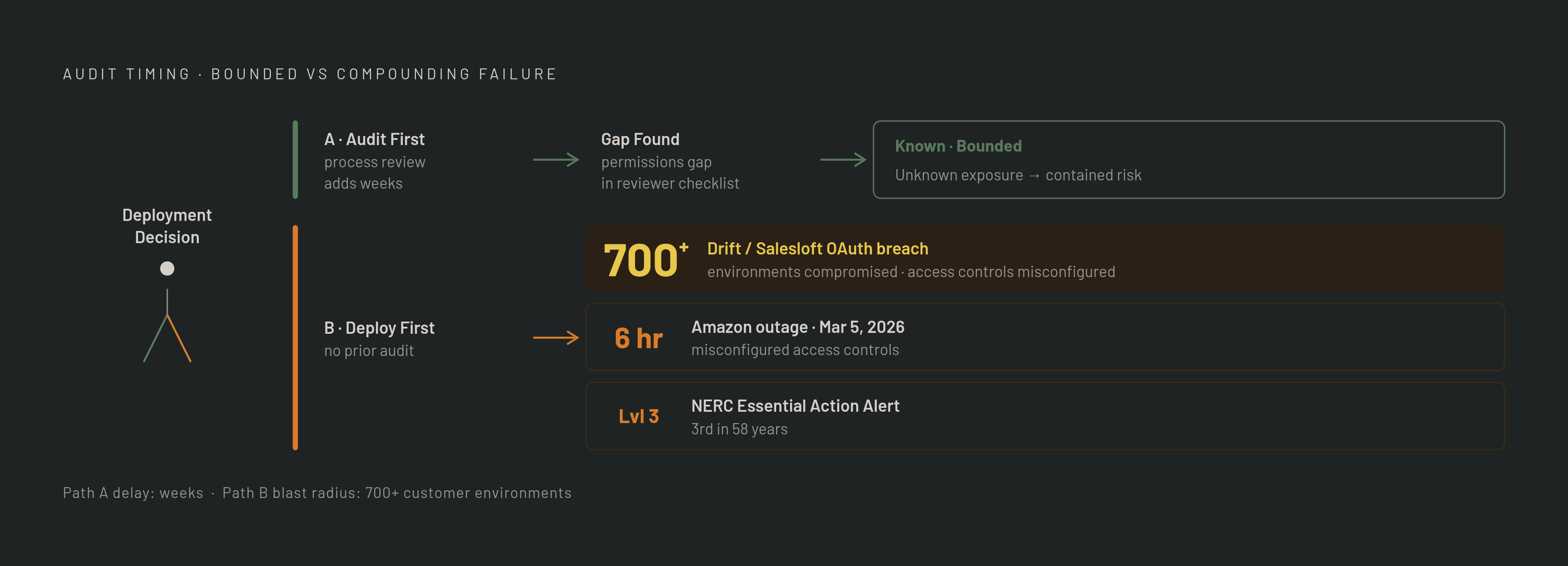
Sequencing an audit ahead of deployment changes what an organization is actually testing. After a failure, the review starts from a breach, an outage, or a scrapped proof-of-concept and works backward, reconstructing a process gap that had been sitting there the entire time. Before deployment, the same gap gets found by a reviewer reading a permissions list, not by an incident-response team tracing an OAuth token propagated across 700+ customer environments in the Drift/Salesloft supply chain attack, a direct consequence of trust chains between agents not being audited before deployment.
Amazon's response to its March 5, 2026 outage, requiring peer review for production access and senior engineer sign-off on AI-assisted changes, addresses the same class of process failure that a pre-deployment audit is designed to catch, misconfigured access controls, a difference of kind rather than degree. NERC's response to cascading grid failures, mandatory registration of large computational loads under Project 2026-02, is a regulatory response to a system-level gap that individual-entity audits had never been built to catch. In both cases, the fix arrived after the cost had already been paid.
An audit conducted first doesn't eliminate risk. It converts an unknown, unbounded exposure into a known, bounded one, and it does that before an AI system has the chance to run a broken process at a speed no one can intervene on in time.